
6 Mar

Six Home Upgrades That Will Make Spring Even Better

General

Posted by: Ethan Jobb

Six Home Upgrades That Will Make Spring Even Better.

As the days get longer and your flowers begin to bloom, there’s no better time to transform your house into your dream home. If you want to unlock your home’s full potential, here are six renovations that can boost both your lifestyle and property value.

Kitchen Transformation

Imagine having a kitchen that not only looks beautiful but also fits your lifestyle perfectly. A kitchen transformation can elevate your home, making it a space where you love to spend time. Whether it’s adding more storage, updating your appliances, or replacing your countertops, now is the perfect time to create the kitchen you’ve always dreamed of. In Canada, a mid-sized kitchen renovation typically ranges from $25,000 to $40,000. An investment that enhances your daily life, as well as your home’s appeal. You deserve a space that works for you.

Roof Replacement

Over time, weather and wear can take a toll on your roof, leading to leaks and potential damage. Replacing your roof this spring restores your home’s safety, boosts its curb appeal, and improves overall efficiency. With modern materials and improved insulation, a new roof offers long-term protection from the elements while reducing the likelihood of future issues. In Canada, the cost to replace the roof on a mid-sized home ranges from $10,000 to $20,000, an investment that offers renewed security and peace of mind for years to come.

Backyard Refresh

Why not turn your backyard into a personal oasis this spring? Whether you’re adding a new deck, fresh landscaping, or an outdoor kitchen, even small changes can make a big difference. Depending on the scope of the project, a new deck may cost between$5,400-$15,000, landscaping updates typically range from, $5,000 to $15,000 and an outdoor kitchen typically starts around $10,000. Whatever your budget, a thoughtful backyard makeover can create a welcoming space to relax and enjoy meaningful moments with family and friends throughout the season.

Siding and Paint Renewal

A siding or paint renewal can really bring new life to your home’s exterior. If your paint is fading or your siding is starting to look worn, it’s not just about looks, it can also leave your home more vulnerable to the elements. Updating with fresh paint or modern siding doesn’t just protect your home but also gives it a clean, refreshed look that you’ll love coming home to. On average, the cost of siding replacement for a mid-sized home ranges from $14,000 to $30,000, depending on materials chosen. Similarly, exterior painting typically costs between $3,000 to $9,000. It’s a simple change that makes a significant difference, especially with spring right around the corner.

New Doors and Windows

Sometimes, we don’t realize how old or worn-out doors and windows can affect the look and feel of our home. Updating them can instantly brighten up your space. A new front door, which typically costs around $3,900 for supply and installation, can instantly refresh your entryway. Replacing outdated windows, with an average cost of $15,000 to $35,000, can also improve natural light and energy efficiency. It’s amazing how these simple changes can make your home feel brighter, warmer, and more welcoming.

New Air Conditioner

You might have noticed that your air conditioning unit isn’t performing as well as it used to, and it may be time to start thinking about a replacement. A modern, efficient air conditioner not only keeps your home at the perfect temperature but also ensures you can enjoy hot days without worrying about your system struggling. On average, replacing an air conditioner in a mid-sized Canadian home costs between$3,500 to $8,500, depending on the type of system and installation requirements.

Renovations can be expensive, and it’s common to feel overwhelmed by the long list of updates you’d like to prioritize. With the CHIP Reverse Mortgage by HomeEquity Bank, these dream projects can become a reality. If you’re 55 or older, you can unlock up to 55% of your home’s equity in tax-free cash, with no monthly mortgage payments required, giving you the funds to complete transformative renovations just in time for spring.

Contact your Dominion Lending Centres mortgage expert to learn more about how the CHIP Reverse Mortgage can help fund your renovations without affecting your savings or monthly budget.

*Please note that all the numbers listed above are estimates and have been sourced from numerous websites. These figures are approximate as they may vary depending on different factors including province, time, market conditions, as well as regulations or policies. *


Ethan Jobb mortgage agent legacy lending team DLC

Published by DLC Marketing Team
1 Mar

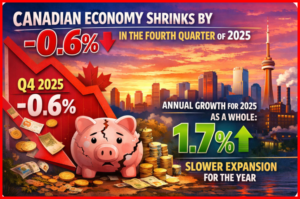
Canada’s Economy Declined by 0.6% in Q4, Taking Overall Real GDP Growth to 1.7% in 2025

General

Posted by: Ethan Jobb

The Canadian Economy Shrinks by 0.6% in Q4, Owing to a Decline in Business Inventories

Statistics Canada reported this morning that the Canadian economy contracted by 0.6% at a seasonally adjusted annual rate, a significant reversal from the 2.4% expansion posted in Q3. The weaker growth rate reflected a steep decline in business inventories, which was partially offset by increases in household spending, exports, and government capital spending.

Economists surveyed by Bloomberg were expecting a 0.2% annualized decline over the last three months of 2025, while the Bank of Canada projected flat growth.

As US tariffs weighed on Canadian exports for much of the year, real GDP increased by 1.7% in 2025, marking the slowest annual growth since the economy contracted in 2020 owing to the COVID pandemic. Lower exports, particularly to the United States, were the main contributor to the slower rise in GDP in 2025.

A preliminary estimate suggests real GDP remained unchanged in January, after increasing by 0.2% in December, slightly stronger than economists’ estimate of 0.1%.

Exports rose 1.5% in the fourth quarter, after increasing 0.9% in the third quarter. The growth in the fourth quarter was led by higher exports of unwrought gold and of unwrought aluminum and aluminum alloys. Despite the increases in the latter half of the year, exports fell 1.7% in 2025, as shipments to the United States did not fully recover following the drop in the second quarter.

Imports edged up 0.3% in the fourth quarter, as higher imports of computers, clothing and footwear, and metal ores were largely offset by lower imports of pharmaceutical and medicinal products. For the year, imports were down 0.4% in 2025, driven by the 2.9% decline in the third quarter.

The better-than-expected Q3 gain will not be sustained in Q4, as Statistics Canada’s advance estimate for October showed industrial gross domestic product fell at a -0.3% monthly pace.

The current overnight policy rate of 2.25% remains stimulative, but until the likely outcome of trade negotiations with the US is resolved, Canada’s economy will be on shaky ground. It is unclear whether the Canada-US-Mexico free trade agreement will be extended beyond this year. If not, Canada will be in for a significant trade policy redo as it seeks replacement markets for its exports.

Household spending rose 0.4% in the fourth quarter after declining 0.2% in the third quarter. Higher expenditures on rent and financial services in the fourth quarter were partially offset by lower spending on new passenger vehicles and alcoholic beverages, as overall expenditures on goods declined for a second consecutive quarter.

On an annual basis, household final consumption expenditure was up 2.3% in 2025, keeping pace with the 2.2% growth in each of the previous two years. The rise in 2025 was led by increased household spending on financial services and rent.

Total capital investment rose 0.8% in the fourth quarter, driven by increased government investment in weapons systems. In contrast, business capital investment edged down 0.1% in the fourth quarter, as both residential and non-residential investment decreased. These declines were moderated by increased business investment in machinery and equipment, primarily computers (+19.6%) and intellectual property products, namely software (+0.7%).

Annually, total capital investment increased 1.4% in 2025, led by higher government investment in weapons systems (+45.9%) and engineering structures (+6.7%). Business investment rose 0.3% in 2025, as higher residential construction (+1.0%) and non-residential construction (+1.6%) were largely offset by weaker investment in machinery and equipment (-3.5%). The year 2025 was the third consecutive year in which government capital investment contributed more to GDP growth than business capital expenditures.

Business residential investment declined in the fourth quarter, led by decreased ownership transfer costs (-2.4%), a measure of resale market activity, and lower renovations (-1.3%). New construction (-0.5%) also declined in the fourth quarter due to lower work put in place for single- and apartment units.

Higher business residential investment in 2025 represented the first annual increase since 2021, as increased new construction (+1.0%) and renovations (+2.7%) more than offset the decline in ownership transfer costs (-3.4%).

Bottom Line

While weaker-than-expected Q4 GDP figures might normally trigger an easing move by the Bank of Canada, the Governing Council has made it very clear that it remains concerned about inflation. Tariff uncertainty is especially high now that the Supreme Court has found the Trump administration misused the International Emergency Economic Powers Act (IEEPA) to impose sweeping, open-ended tariffs — striking down the legal foundation for a central pillar of the administration’s trade strategy.

The decision removes the fastest way to impose broad country-level duties, but it does not end the tariff debate. Other statutory authorities remain in play, and businesses and trading partners are left to assess what comes next.

The ruling also lands amid sustained political pressure around affordability, which may shape how aggressively trade tools are redeployed. Even if tariff rates decline, businesses must now assess whether alternative authorities will be used to reimpose them. For the real economy, restoring stability may matter as much as reducing tariffs themselves.

Please Note: The source of this article is from SherryCooper.com/category/articles/